Multipoint Wirless Technology
What is Point-to-Multipoint Wireless?
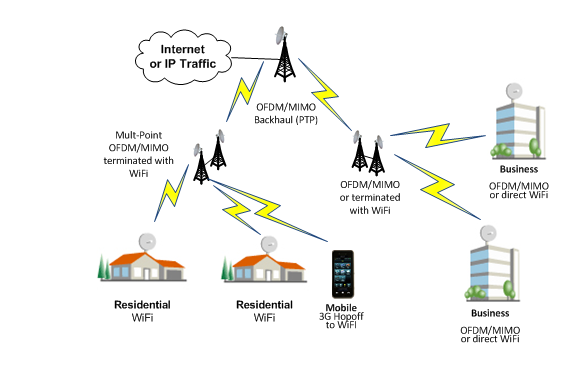
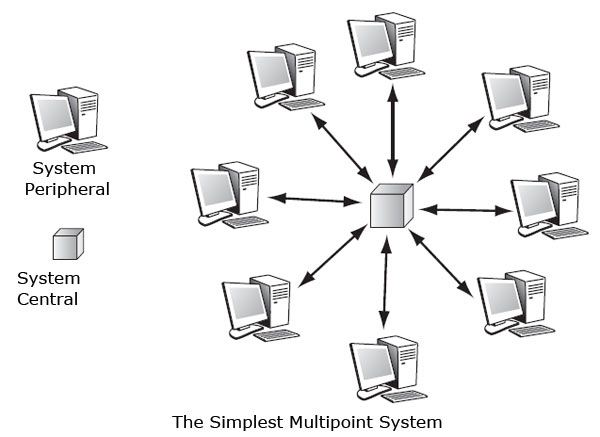
“Point-to-multipoint wireless” is a term that describes a technology, not a single particular solution. Point-to-multipoint wireless is defined by the fact that one of the devices in the network (the “point”) can communicate over radio waves with several other devices at the same time (hence “multipoint”).Devices in the former class are usually dedicated to serving as communication nodes and are called base stations. The latter are usually called “endpoints” or “subscriber units”.
They are connected to (or embedded in) local data networks, devices such CCTV cameras, data logging units or other types of security devices, and are the source of network traffic. These devices do not communicate directly with each other, but via the base station, which can relay data between them.
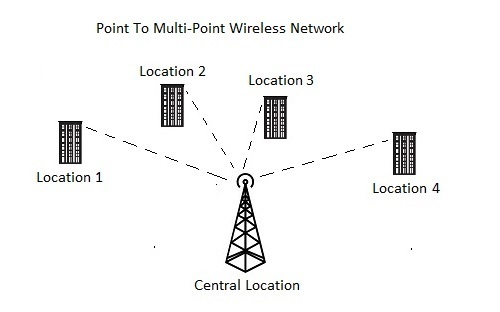
In larger deployments, the base station will have a dedicated (often point-to-point) link to a core network, which relays data over much longer distance — tens or hundreds of kilometers. This scenario is called “backhauling”.
PTMP describes a network *topology* — i.e. how devices are connected — not a protocol. PTMP networks can operate using various protocols, such as LTE (licensed or unlicensed) or MPLS, which can carry regular IP data.
In other words, Ethernet or fiber networks can be freely interconnected using PTMP wireless links. The interconnect is transparent to the network devices.
There are three frequency ranges that are typical for point-to-multipoint wireless links:
- RF, in the 700-900 MHz region. Equipment operating in this radio region tends to require the least complex technology, but this is a busy region of the frequency spectrum and only a small portion of it is deregulated and accessible to unlicensed users.
- Microwave, most commonly around the 2.4-2.7 GHz, 5.4-5.8 GHz, 10.5 GHz and 26-28 GHz regions. Much of the microwave spectrum in these regions deregulated, but is often used for short-distance operation.
- Millimeter-wave region (58 – 90 GHz region). Equipment operating in this region is typically used for high-bandwidth applications, as the complexity of the installation and maintenance, and of equipment itself, make low-speed operation difficult to justify.
Microwave-region PTMP links are the most common. They strike a good balance between spectrum availability and cost, and equipment in this class is reliable and reasonably easy to install and maintain.